
































This section will provide you with advice on improving your score on the math component of the test. Click on a link for help in one of the following specific topics:
New - Practice Math Questions - Click Here
Logic & Problem Solving
Almost every police service entrance exam contains some form of logic or problem solving questions. These can be in the form of mathematically based word problems such as:
John had seven apples but ate two. How many remain?
They may also take the form of solving a logic word puzzle not involving mathematics, such as:
Susan was walking north on Jane Street before making a left turn on Steeles followed by another left turn on Maple Road. What direction was she travelling on Maple Road?
It is important to be able to work through these questions quickly and efficiently. The key to success with these types of questions is practice. The more you practice performing problem solving or logic questions, the better you will become. Each questions is different and unique, so there is no specific formula you can always follow. There are however some strategies and techniques to be aware of.
Problem Solving Questions (Math Based)
Before even attempting to become proficient at problem solving questions, practice your basic math skills. Be competent with all basic math operations such as addition, subtraction, division, multiplication, algebraic equations, fractions, decimals, percentages, etc. You must be able to perform these tasks competently and quickly using pencil and paper. Once reasonably competent with basic math skills, you can begin tackling word math problems.
Step 1: Identify what is being asked. What are you trying to solve? Respond directly to what the problem is trying to ask. Once you have identified what is being asked, you will have to find out what additional information has to be worked with.
Step 2: Respond to what is being asked. What would I do, or how would I answer the question that is being asked? As you start working through and sorting the information in the question, you will start to realize what information you need to answer the question. Data within the question will have to be manipulated in some way (adding, subtracting, multiplying, creating an algebraic equation, etc.) in order to reach a conclusion. Some questions you will have to ask yourself are:
1) Do I have the right information (is there enough, too much, in a suitable form?)
2) What operations should I use (add, divide, etc.)
3) This basically involves setting up an algebraic equation.
Step 3: Generate the Result. Perform the necessary calculations to determine the answer to the question asked.
Example 1:
Jordan has 10 chocolates and 4 times as many pieces of caramel. How many candies does he have?
1) Problem asks for the total amount of candy.
2) Amount of candy = number of chocolates + number of caramels
Chocolates = 10 Caramels = 4 x 10 (four times as many)
10 + 4 x 10 = Total amount of candy
3) 10 + 4 x 10 = 50 pieces of candy
Practice doing as many problem-solving questions as possible and review any detailed answer explanations for questions which confuse you.
Logic Questions
Logic questions can also be solved using the same process, but different tools have to be used for the latter steps.
Step 1: Find out and be clear what is being asked. Make sure you know what you are trying to answer.
Step 2: Respond to the request. How would you solve it? Some common methods used to solve logic problems include the following:
1) Creating diagrams or lists (especially for determining orders of things or events)
2) Creating graphs or charts (especially useful when attempting to organize data)
3) Drawing maps (these are common for determing direction)
4) Combining multiple processes (especially for complex problems)
Step 3: Generate the result. Work through the data to solve the problem being asked.
Example 2:
Michael is older than Joseph. Joseph is between Michael and Audrey in age. Cheryl is the oldest. What is the order of the group of four from youngest to oldest?
1) Problem wants to know the order of age from youngest to oldest of four people.
2) Attempt to map out the individuals on a list, with the youngest being the lowest on the list and the oldest being highest.
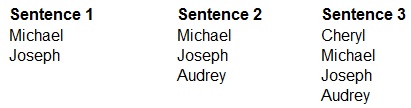
3) Audrey is the youngest followed by Joseph, Michael and Cheryl.
Example 3:
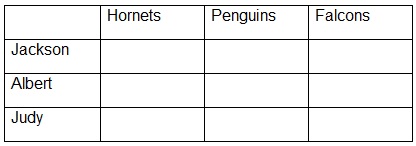
Jackson, Albert and Judy each play on different sports teams. Judy does not play on the Falcons. Albert played against Jackson`s team which was the Hornets. The other team is the Penguins. Who plays on what teams.
1) Problem wants to know which player plays for which team.
2) Create a table to organize the data.
3)
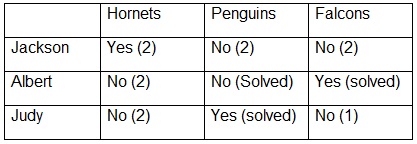
Jackson – Hornets Albert – Falcons Judy - Penguins
As with problem solving questions, practice doing as many logic questions as possible and review any detailed answer explanations for questions which confuse you.